Imaging Session Details
Lower's Nebula 2025
Lower’s Nebula: A Three-Filter Journey Through Hydrogen, Oxygen, and Sulfur
Processing a faint winter target with 28 hours of data across SV220, Askar D2, and LPRO filters
Revisiting a Faint Winter Target
Lower’s Nebula in Canis Major doesn’t show up on many “best of winter” lists. It’s faint, it’s diffuse, and it lives in a part of the sky dominated by flashier neighbors like the Rosette and IC 410. But with enough integration time and the right filter combination, it rewards patience — and after January’s bird-poop-on-the-lens incident, I was ready for a target that would pay off rather than punish.
Taming the Great Nebula: MGC Settings for M42
Taming the Great Nebula: MGC Settings for M42
A practical guide to MultiscaleGradientCorrection for extremely bright targets across multiple filters
The Orion Nebula (M42) is one of astrophotography’s most rewarding yet challenging targets. Its extreme dynamic range—from the blazing Trapezium region to the delicate outer wisps extending into the surrounding molecular cloud—makes gradient correction particularly tricky. In this post, I’ll walk through my experience using PixInsight’s MultiscaleGradientCorrection (MGC) tool on M42, including the pitfalls I encountered and the settings that finally worked across three different filters.
October Imaging Update
This month has brought clear skies to Texas and lots of imaging time. I’ve managed to capture a few targets including: North America Nebula, Clam Nebula, Tulip Nebula, and Orion’s Nebula.
These image sessions were all driven by NINA, and have revolutionized imaging sessions for me. There is no longer a need to sit and watch the telescope while it images, I have managed to automate the process and capture 2-3 targets in a night. I’m quite pleased with the transition from Stellarmate, however I do miss the ease of using an app to control everything.
August 7 2024 Astro session
I did note that I would try to analyze subframes in the last post, but I thought it was worth a shot to take some pictures. The target was NGC 6974, one of two luminous knots within the Veil Nebula. It was particularly tricky because of the scattered clouds in the evening. It started fine, with the polar alignment taking almost no time at all. Focusing with SVBony’s SV220 Ha+OIII filter was not challenging at all. Once I slewed to the target things got worse. There were scattered clouds hindering the guiding, so I waiting a bit until they passed. Once they had passed, I continued the guiding assistant in PHD2 and then realigned on NGC 6974 to start guiding. I had to interrupt the session while clouds came in, then started it again when they passed.
Repeat Astro session
Last night’s (August 06, 2024) session started fairly late. I had initially checked the weather and it showed clear skies. However, when I went outside at 9pm it was raining. Perfectly over my area, there was a rain cloud. At around 10:30pm, the rain was gone and the clouds started to drift away. After setting up, polar aligning and focusing, I was able to capture an additional 20 subframes with the Askar D2 filter.
August 5 2024 Astro session
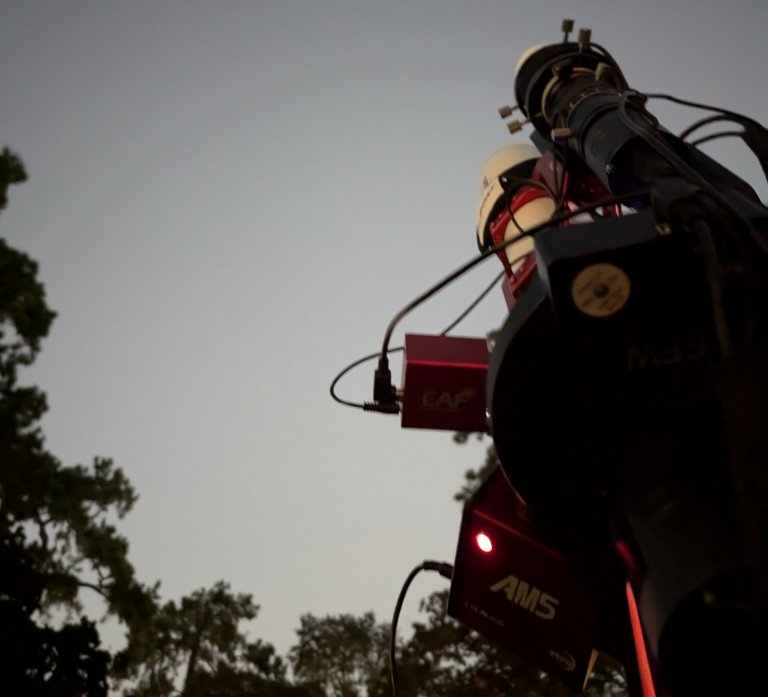
Tonight’s session started around 9:30pm US Central time, under Bortle 9 skies. Polar alignment and focusing took a little extra time due to clouds and poor visibility. However, once completed the night cleared up a bit and alignment to my target went better. I ran the guiding calibration, although it was not in a recommended location for calibrating, then I ran the guiding assistant tool and applied the recommendations. My equipment was able to guide between 18 and 22 rms. After that, the imaging session began. I was able to capture 20 subframes before I was ready to pack up.